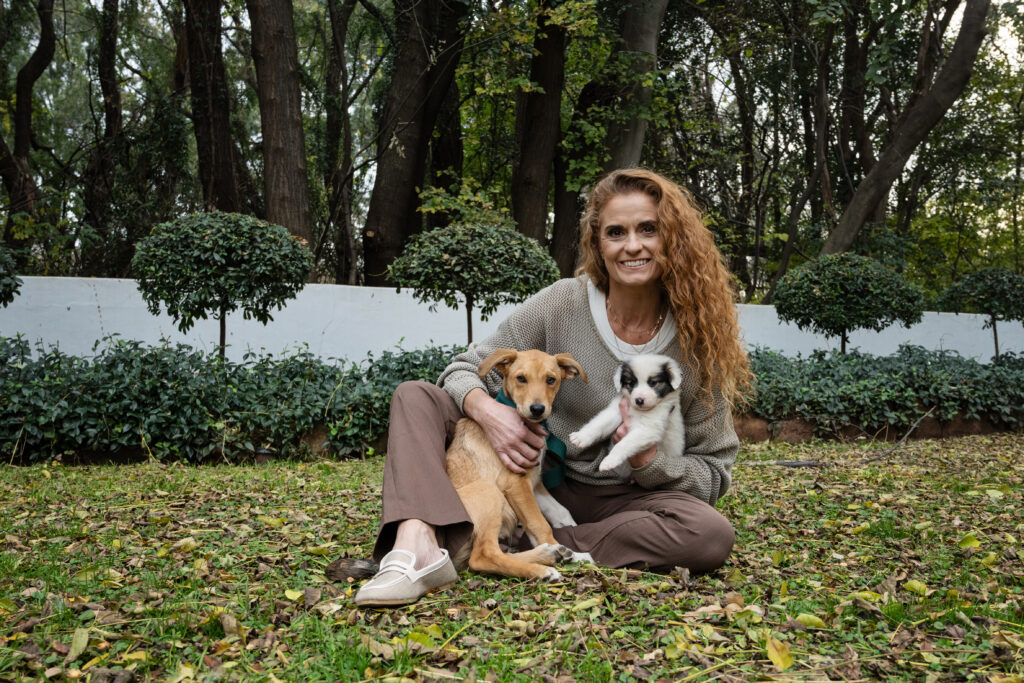

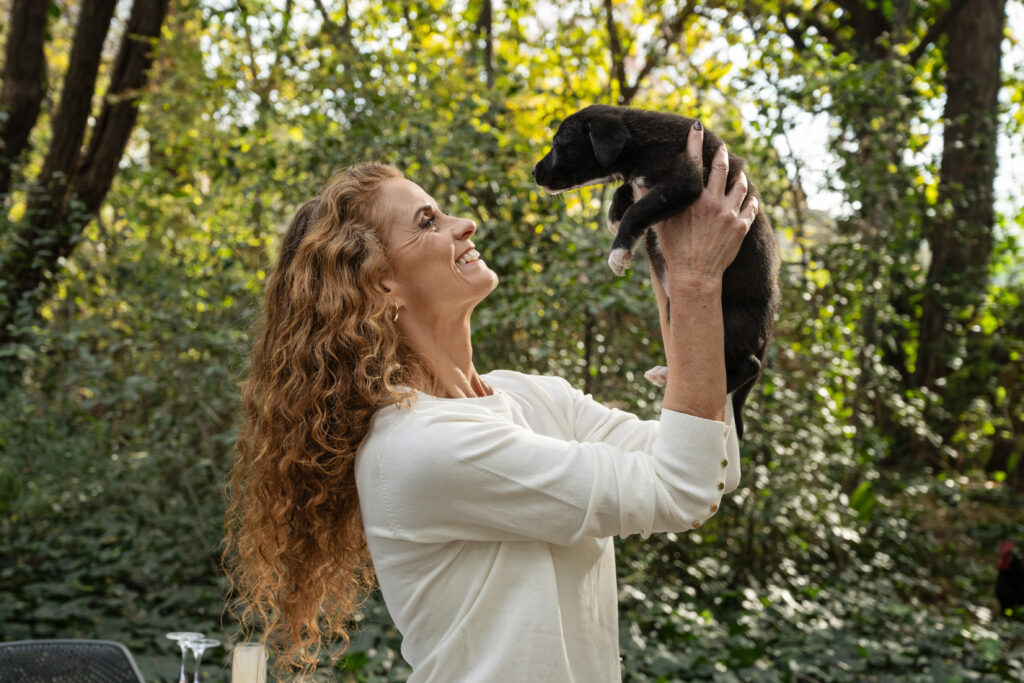
On a beautiful afternoon at Klein Kaap Boutique Hotel in Centurion, a group of rescue puppies stole the show. They tumbled across the lawns, explored every corner they could find
and eagerly soaked up the attention of everyone around them.
In front of Emma O’Brien’s camera, they looked carefree and full of possibility, exactly as puppies should. Yet, each one carried a story. Some had arrived unwanted. Some had been abandoned. Some had been born into circumstances where survival was uncertain from the very beginning. But on that day, none of that mattered.
For a few precious hours they were simply puppies being loved, cuddled and celebrated.
Standing amongst them was Michelle Weedman from CLAW (Community Led Animal Welfare), a woman who has dedicated years of her life to helping animals find safety, dignity and a second chance.
As we prepared this issue of Pet Prints, centred around the theme Heart & Home, it quickly became clear that Michelle’s story perfectly embodied what this edition is all about.
Because after spending years helping vulnerable animals, Michelle has learned something profound: Home is not a building. Home is a feeling. And every animal deserves to experience it
Words by: Marise Burger and Michelle Weedman
Michelle’s journey into animal welfare wasn’t carefully planned. In fact, it started somewhere completely different. She was volunteering at a children’s feeding scheme that operated from CLAW’s premises. Saturdays were spent baking muffins, packing meals and creating positive experiences for children in the community.
“I was originally involved in the children’s feeding scheme based at CLAW,” Michelle explains. “Our Saturday mornings were spent playing and interacting with children, enjoying laughter and distributing meals.” While helping with the feeding programme, she regularly found herself walking past the dogs and puppies being cared for by the welfare organisation. Something about them drew her in. Week after week, she spent
a little more time with the animals. Week after week, her involvement grew.
“The more time I spent at CLAW, the more I became involved. I felt a natural pull toward the animals.” At first, she simply wanted to help wherever she could. She never imagined it would eventually become her life’s work. “I grew up in an animal-loving family and always had a passion for animals,” she says. “The more I got involved with CLAW, it led me to discover that this was my ultimate calling.”
Today, she considers herself incredibly fortunate that helping animals is no longer something she does in her spare time. It’s part of who she is.
THE ANIMALS NO ONE SEE
Animal welfare is often portrayed through happy adoption photos and heartwarming rescue stories and while those moments certainly exist, they represent only a fraction of the reality. Behind every success story are long days, difficult decisions and emotional challenges that most people never see.
Michelle works with animals who have experienced neglect, abandonment, abuse and
hardship. Animals that cannot explain what happened to them. Animals that cannot ask for help. “My heart goes out to those in need,” she says simply. “They cannot ask for help.”
It’s a sentiment that sits at the centre of welfare work.
Many of the animals arriving at CLAW have never experienced consistency, safety or kindness. Some are frightened of people. Others are injured or ill. Some have simply never known what it feels like to belong. Yet one of the most rewarding parts of Michelle’s job is watching those animals slowly begin to be trusted again.
Even within a busy welfare environment, she says animals adapt remarkably quickly
“They realise that you are not causing harm and only mean well by feeding and nurturing them. ”The transformation is often subtle. A tail wag. A relaxed posture. A willingness to approach instead of retreating. A spark returning to their eyes
For those working in rescue, these small moments carry enormous meaning. They signal
that an animal is beginning to feel safe. And safety is often the first step toward finding home.
A HOME IS MORE THAN FOUR WALLS
When we asked Michelle what the word “home” means to her, her answer was immediate.
“Home is all about a happy space, good energy and love.” It’s a simple answer, but perhaps that’s what makes it so powerful.
In a world where people often associate home with property, possessions and material success, animals remind us that the things that matter most cannot be bought. Animals don’t care how expensive the furniture is. They don’t care how big the garden is. They don’t care whether the house is grand or modest. What they care about is connection, trust consistency and love.
“Animals don’t see material objects in a home,” Michelle explains. “That’s not what gives them comfort.” Instead, they look for something much deeper. “They feel trust and a sense of belonging when loved and cared for. If they have a connection with a family, that’s when they accept they are home.”
It’s a lesson many humans could probably benefit from remembering.
THE LINK BETWEEN PEOPLE AND PETS
One of the biggest misconceptions about animal welfare is that it’s only about animals. Spend time with organisations like CLAW and you’ll quickly realise that’s far from the truth. Animal welfare and human wellbeing are deeply interconnected. The communities served by CLAW often face significant economic challenges, yet Michelle says one thing continually stands out. The love people have for their animals.
“There is a powerful connection between human and animal wellbeing,” she says. “Most of the communities we work with are impoverished, yet they love their animals deeply.”

“Most of the communities we work with are impoverished, yet they love their animals deeply.”
Families feel empowered when they can properly care for their pets. Children learn compassion and responsibility. Animals receive healthcare, nutrition and protection.
The benefits flow both ways.
CLAW’s work therefore extends beyond treating injuries or facilitating adoptions. Through education, sterilisation programmes and primary healthcare services, they help create healthier communities for both people and animals.
“We cannot ignore the needs of the humans involved,” Michelle says. It’s a philosophy that recognises an important truth: helping animals often means helping people too.
KEEPING FAITH IN HUMANITY
Working in welfare inevitably exposes people to difficult situations. The cruelty, neglect, abandonment and suffering are hard to ignore. It would be easy to become cynical.
Yet, Michelle says the communities she serves continue to restore her faith in people. “The communities we serve are challenged financially, yet they still care about the animals and people around them.” Time and time-again she encounters individuals who share what little they have, step forward to help a neighbour’s animal or make sacrifices to ensure their pets receive care.
“Even though we encounter cases of neglect or cruelty, we often see individuals that are kind and generous. This reminds me that our country still has a good amount of soul and
compassion.” Those moments matter.
Because while the difficult cases can weigh heavily, the acts of kindness remind welfare workers why they keep showing up.

RESILIENCE
Ask Michelle what animal welfare has taught her and the answer
comes quickly. “Welfare work has taught me resilience I have never
experienced before.”
The challenges never stop. The next call always comes. The
next rescue is always waiting. The next animal needing help is
never far away. Yet somehow, through every challenge, welfare
workers keep moving forward.
Michelle describes it as a little voice in her head that tells her
to keep pedaling and perhaps that resilience comes from
witnessing resilience in animals every single day.
After all, few creatures demonstrate courage quite like
an animal that chooses to trust again after experiencing
hardship.
It’s also taught Michelle that CLAW is her home. “The
welfare space has been extremely rewarding and
brought me great comfort over the years,” she says.
For many people, work is simply a job. For
Michelle, it became something more. A
community. A place where her values and her
daily life aligned and ultimately, a home.
We often talk about responsible pet
ownership, adoption, rescue and welfare,
but at the heart of all those conversations
lies one simple goal. Creating homes. It’s
easy to get caught up in the “Instagram”
of it all and expect the doggy birthday
cake or the cute outfits, but it’s about
more than that. Finding animals a home
that has all the needs met with safety,
food, exercise and love, that’s what it’s all
about.
As Michelle reflects on the thousands of
animals whose lives have crossed her
path, her definition of home remains
wonderfully uncomplicated
“Love, happiness and safety.”
Three words. Three things every animal deserves.
When asked what the animals she has helped over the years might say to her if they could speak, her answer is equally simple. “Thank you for not giving up on us.”
Perhaps that is what makes organisations like CLAW so special. They refuse to give up and continue showing up for the animals that nobody else notices. They continue believing in second chances and create opportunities for belonging.
In doing so, they remind all of us that home is far more than an address. It’s a feeling. It’s knowing you are safe, loved and that you matter. Or as Michelle puts it so beautifully:
“Home is the place of people and the feeling of love.”
For the rescue puppies that joined us on our cover shoot, for Marshall, for every animal still waiting for their chance, and for the countless lives touched by CLAW over the past 34 years, that feeling is everything.