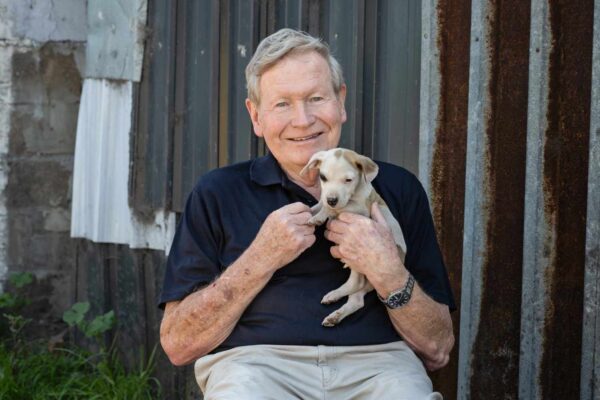
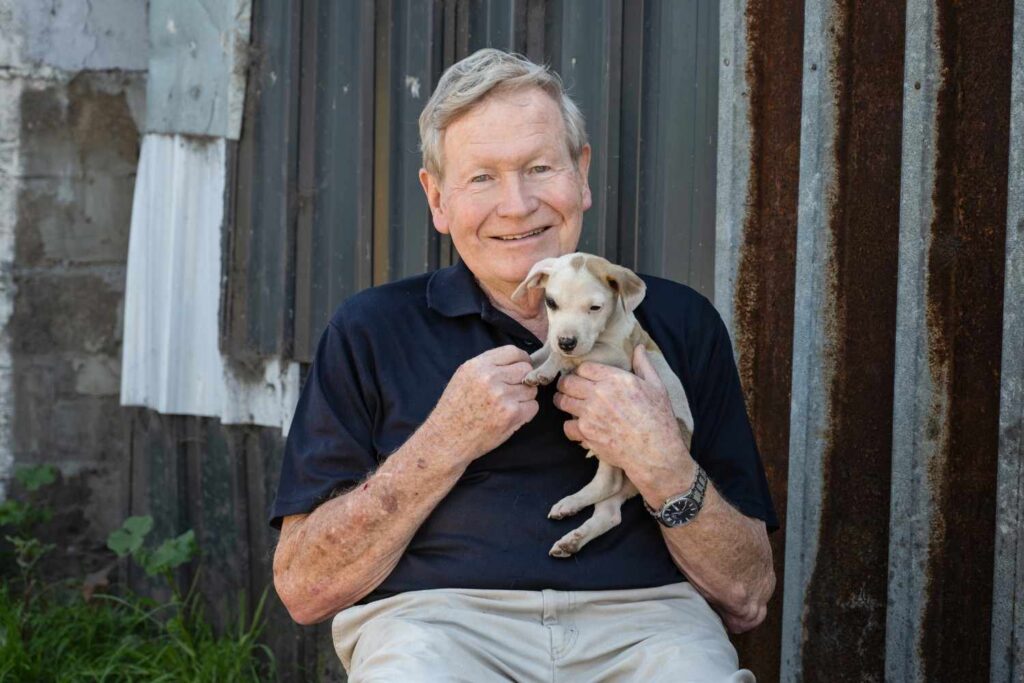
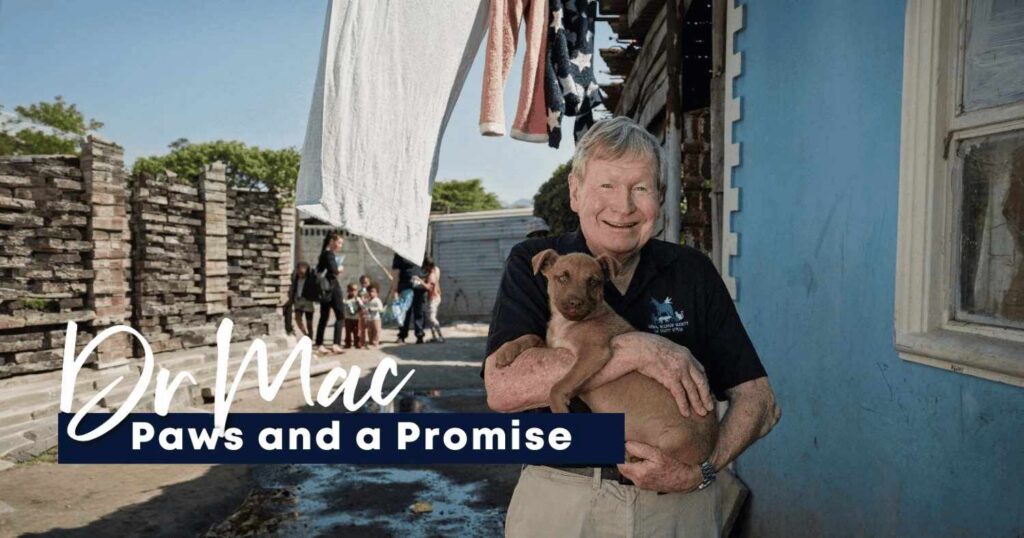
Dr John “Mac” McMullen arrived in Cape Town on his way to America. Fifty years later, the young Irish veterinarian who promised not to let one small welfare society down is still here, and thousands of animals and families are better for it.
There are some people whose lives seem to be shaped by a single, dramatic decision. For Dr John McMullen, known simply and affectionately as Dr Mac, it was something far quieter. A visit. A handshake. A promise made in a modest animal hospital with very little money, almost no equipment and more need than any one person could possibly meet.
“I said I wouldn’t
let them down.”
When we sit down at the Animal Welfare Society of South Africa in Philippi, the hospital tells a story of its own. Animals rest in clean wards. Staff move purposefully through the passages. Behind theatre doors, lives are being repaired in a hospital offering private-practice standards to those who need them most. It is difficult to reconcile this place with the one Dr Mac first walked into in 1975.
Back then, Cape Town was never meant to be home. He had come to visit his brother while on his way to join a colleague in New York. Then his brother and sister-in-law left for the Greek Islands and Dr Mac, bored with babysitting and curious about the possibilities around him, began knocking on the doors of veterinary practices.
The answer was not encouraging. The profession was, as he remembers it, a closed shop. A foreign-qualified vet was not particularly welcome. So, he turned to welfare organisations and, through someone connected to the Animal Welfare Society, met the woman who was then its CEO. The Society did not have a veterinarian of its own. Private practices sent out young, inexperienced vets and charged for each item of work. AWS needed someone permanent. Dr Mac offered them a year.
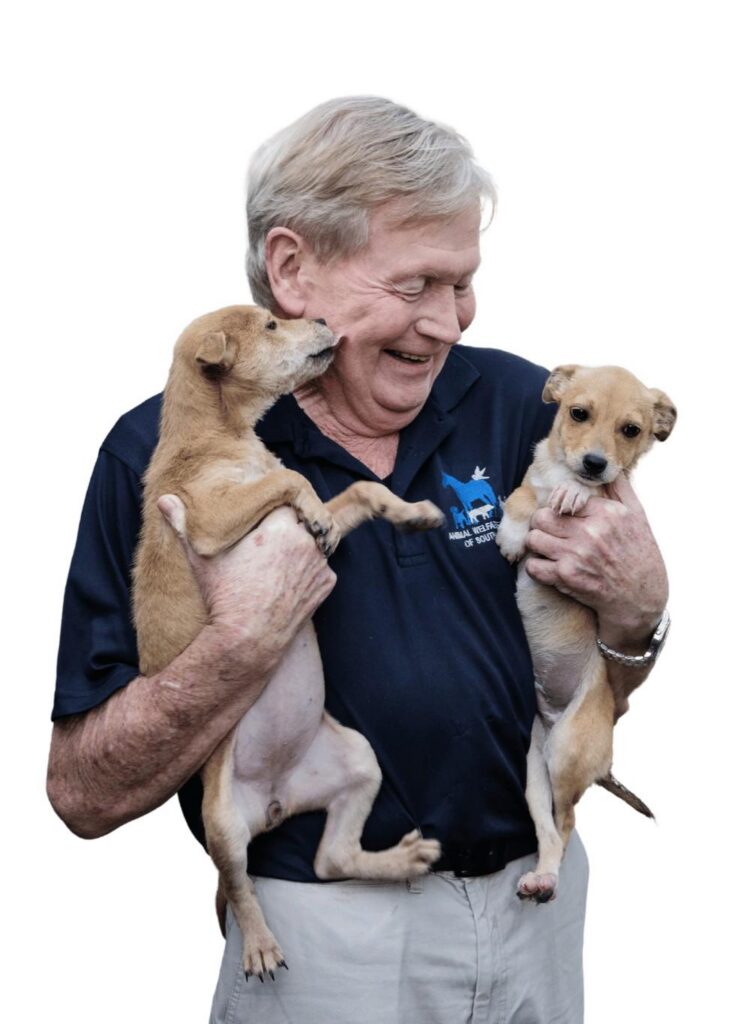
He would work exclusively for the Society, he said, provided he could open his own practice afterwards if everything went well. More importantly, he told them, “I won’t let you down.” There was no lengthy legal agreement and no carefully negotiated package. There was a handshake, a salary of R600 a month and a seven-day working week.
His recollection of that first day is wonderfully blunt: “It was terrible.”
Not knowing which way was up or down, a language barrier and a translator was all he had to survive those first few weeks. He jokingly remembers that he quickly got to know all the Afrikaans swear words remarkably fast.
The first months were exhausting. The hospital was small and desperately poor. There was no proper surgical equipment, so they searched hospitals for redundant stock and gathered second-hand instruments wherever they could. Piece by piece, they built what he calls their “small arsenal of tools”. In the process, the young vet acquired the surgical skills that necessity demands and textbooks cannot fully teach.
One year passed. Dr Mac opened his own practice with a partner who understood welfare work. It eventually grew into seven practices in Cape Town and two overseas, but the promise remained.
“I said I wouldn’t let them down,” he tells me, as though five decades of service were simply the obvious consequence of giving one’s word.

For years, that handshake was the entire contract. It was only in 2016, when the executive committee asked to see the paperwork, that everyone discovered there was none. A formal contract was finally drawn up, more than four decades after the work began. There is something beautifully fitting about that. The earliest foundations of this place were trust, loyalty and a man who meant what he said.
Today, AWS Philippi has a refurbished hospital and offers almost every service available through a private veterinary practice. The team performs around 30 orthopaedic procedures a month for animals whose owners could never afford that care elsewhere. There are still limitations. Dr Mac would love an ultrasound machine, and funding remains the quiet ache beneath almost every welfare conversation. Donations towards sterilisation projects often cover only a third of what is needed.
Yet, what this relatively small team produces is, in his words, phenomenal. Together, they operate not as a corporation but as something much more personal.
When I ask him to describe AWS Philippi in one word, he answers without hesitation: “Family.”
That word matters here, because Dr Mac’s understanding of welfare has never stopped at the animal in front of him. It reaches down the lead to the person holding it and, often, to the child walking beside them.
Years ago, AWS recognised that changing animal welfare meant teaching children. Without education, young people may grow into adults who do not recognise suffering. The team began visiting schools, welcoming learners to the hospital and working with children in surrounding communities. They became AWS’s “little ambassadors”, watching for animals that needed help.
Some have walked kilometres to find that help.
The one particular story that comes to mind is that of Gerry and his brother, Peter, two small boys who travelled five kilometres over unforgiving terrain, without shoes, carrying a sick dog almost as big as they were. The image is difficult to forget. Little bodies bearing the weight of an animal they loved because leaving her behind was never an option. Their circumstances were dreadful, but their compassion was not diminished by what they lacked. AWS later watched the boys grow, helped by donations that included bicycles, and saw one become a more responsible young adult.
This is the truth Dr Mac wants people to understand about pets in lower-income communities. Love is not measured by a bank balance. People love their animals, and their animals love them. What may be missing is access, transport, knowledge or the ability to recognise how serious an injury has become. In earlier years, the welfare team had to travel out and search for animals in need. Today, a mobile phone can bring help to the right place far more quickly.
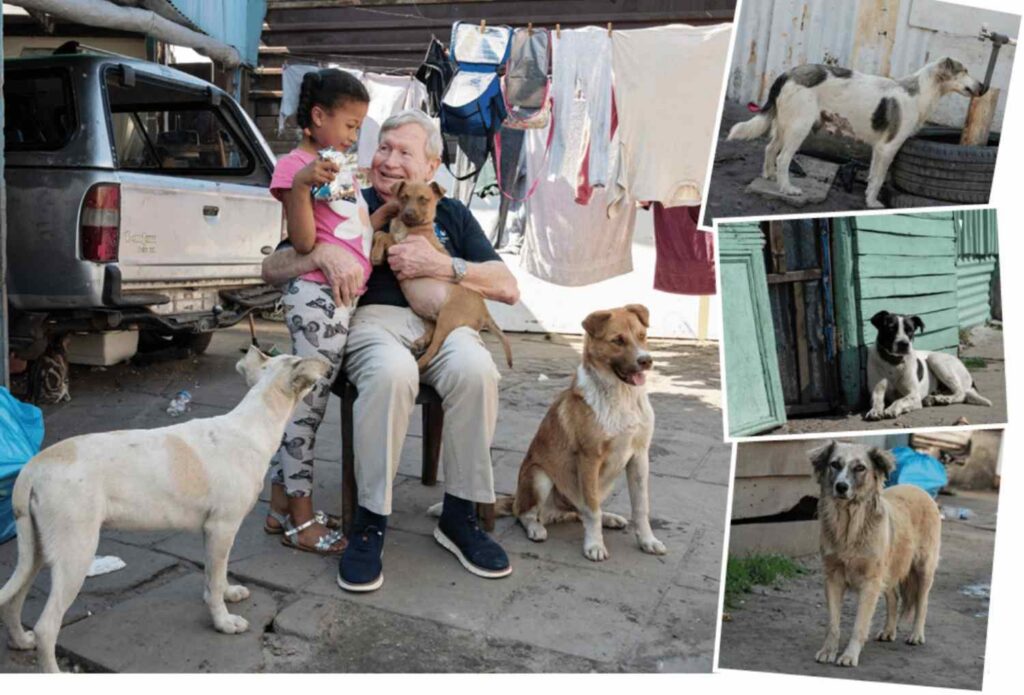
Nor is financial hardship confined to one community. Private practices also refer clients who, through no fault of their own, cannot afford an operation. They arrive at AWS carrying beloved members of their families. “They’re lucky we are here,” Dr Mac says. He is right, although he would resist the suggestion that much of that luck began with him.
One of the things I always ask people working in welfare is: “How do you do it?” “How do you stay so strong and not let the sadness of this work overwhelm you?” It’s a tough question, because the majority of people have always answered this with, “I’m not sure, I just do it” or “It does get to me sometimes.” But Doctor Mac’s answer really got to me. I think in psychology they call this the contrast effect.
.
A repaired leg is not simply a procedure
completed; it is a triumph. A child asking for help is proof that education has taken root. An animal going home is a small victory carried back into a family and a community.
You become accustomed to seeing both the best and the worst, he says, and once you have seen the truly terrible cases, “the best is even better”. Against that darkness, every recovery shines more brightly. A repaired leg is not simply a procedure completed; it is a triumph. A child asking for help is proof that education has taken root. An animal going home is a small victory carried back into a family and a community
This answer to me is the best example of hope that I’ve heard in a very long time. If someone of seventy-eight can see the silver lining after all the things that he’s seen in more than fifty years in welfare, who are we to say that there’s only doom and gloom in the sector.
When we speak about legacy, Dr Mac does not describe a plaque, a title or a list of personal achievements. To him, legacy is something taught or left behind that continues to move without you. It becomes self-perpetuating. It grows. It accelerates.
QUICK-FIRE WITH DR MAC
CATS OR DOGS?
Both. I refuse to choose.
PUPPIES OR SENIOR DOGS?
Senior dogs. They are particularly special for someone whose circumstances have changed.
EARLY-MORNING RESCUE OR MIDNIGHT EMERGENCY?
Neither, these days but when you have to go, you go.
THE MOST STUBBORN ANIMAL?
People.
THE MOST MISUNDERSTOOD ANIMAL?
Chickens. They are not quite as sensible as dogs and cats, which can make them a little more difficult to understand.
THE ANIMAL MOST LIKELY TO OUTSMART A VET?
A dog.
YOUR FAVOURITE IRISH COMFORT?
Irish single-malt whiskey.
TEA OR COFFEE AFTER A DIFFICULT SHIFT?
Tea.
ONE THING EVERY PET OWNER SHOULD KNOW?
Get pet insurance.
ONE THING EVERY YOUNG VET SHOULD LEARN?
Patience. Especially if they want to work in animal welfare, where they will not always have all the equipment and resources available in private practice.
AWS PHILIPPI IN ONE WORD?
Family. We are a relatively small team, but the impact we make together is phenomenal.
THE PAST 50 YEARS IN ONE WORD?
Amazing.
RETIREMENT: A REAL PLAN OR AN ONGOING RUMOUR?
An ongoing rumour. At AWS, we prefer to call it a succession plan.
You can see that legacy everywhere at AWS Philippi. It is in four theatres where once there were scavenged instruments. It is in staff who know excellence should not depend on income, in children who notice suffering and in every animal carried through the doors by someone determined not to give up.
But his most important message is also his simplest. If you take on an animal, you take on a life. Not a Christmas present or a birthday surprise to discard when it becomes inconvenient. A life. That animal is family until the very end, and that end should be met with compassion and dignity, never abandonment.
Dr Mac arrived in Cape Town intending to pass through. Fifty years later, he is the third CEO of an organisation that has outgrown its humble beginnings without losing its heart. He speaks of those who came before him, Miss Atkins and June Woodman, with affection, and of those who will follow with certainty. There are, he says, many more chapters still to come.
As I leave the hospital, I keep returning to that first handshake. Dr Mac promised he would not let them down. He meant the Society, of course. But in keeping that promise, he did not let down the animals, the families who loved them, the barefoot children who carried them or the generations of young vets who would learn that welfare is not simply a branch of medicine. It is a calling.
Some legacies are carved into stone. Others breathe, heal, teach and carry on. Dr Mac’s has four paws, countless faces and a pulse that can be felt throughout Philippi. And much like the man himself, it shows no sign of retiring. Apparently, the more acceptable phrase is succession plan.