
Paws in the Overberg: Julie Berkman- Fluckiger’s Guide to Stanford
BY BRIAN BERKMAN
Julie Berkman-Fluckiger sniffs out a remarkable stay at a fire-restored Stanford home – Die Kuierhuis – and reports back.
My humans call it a road trip. I call it the greatest olfactory adventure of my life. When Brian Berkman and JP Fluckiger loaded the car and pointed it east along the coastal road, twenty minutes beyond Hermanus towards Stanford, I assumed we were heading for the usual Overberg pleasures: salt air, fynbos, and the occasional dassie to out-stare. What I did not anticipate was spending the weekend in a house so full of extraordinary smells, linseed oil on restored floorboards, fresh paint layered over a century of stories, woodsmoke embedded in old plaster that I barely slept for listening to the walls and the tap-tap of the rain on corrugated roofing.
The property had been through its own drama. A fire had left the interior smoke-damaged and the owner, writer and entrepreneur Lanie van Reenen, combing through the wreckage. What emerged was something far more interesting than a mere renovation. Lanie rebuilt with restraint and intention, and Home magazine thought it worth celebrating in a feature which you can read when you get there. Having spent a weekend padding between its rooms, I am inclined to agree.
The house, at 38 Queen Victoria St, announces itself through layers. The stoep, half-sheltered, half open to the garden, is furnished with confident eclecticism: a carved wooden bench dressed in ikat cushions, a bold black-and white striped armchair bearing a remarkable beaded cushion portrait of an African figure, a diamond paned window set at a jaunty angle in the white-bagged brick wall. It is the kind of space that makes you want to sit down immediately. I did.
Inside, four bedrooms and four bathrooms are laid out with the easy logic of a house that has been properly lived in. The open plan dining room and sitting room is a particular triumph: a long oak table paired with white folding chairs sits beneath an enormous floor-to-ceiling wall hanging made up of owner Lani’s grandchildren’s paintings. It is an exuberant, graphic textile alive with illustrated motifs in every colour.
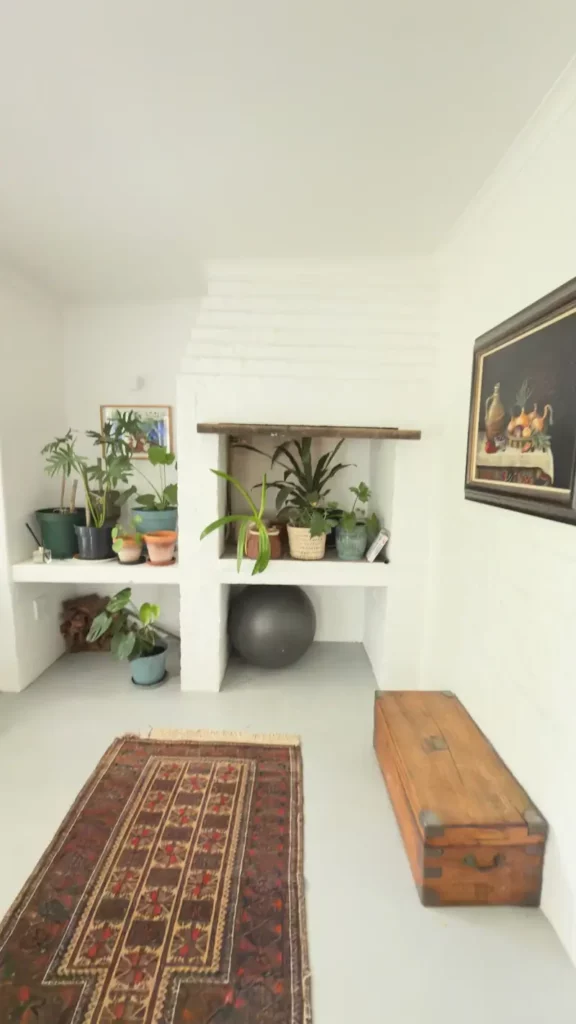
A magnificent dark wood Victorian sideboard with a mirrored back anchors the opposite wall. Original hardwood floors glow warmly underfoot, and a doorway frames a glimpse into the quieter sitting room beyond, where potted plants colonise a white-painted fireplace alcove and a Persian runner adds depth and warmth to the painted concrete floor.
The bedrooms are each their own world. In one, whitebagged brick walls and tongueand- groove ceilings create a cool, calm envelope around a bed dressed in a cheerful plaid throw and green patterned cushions – simple, honest, deeply restful. In another, a dramatically dark botanical wallpaper mural, enormous illustrated flowers and seed pods against a near-black ground transforms the space entirely, offset by a white iron bedstead, an ochre throw, and painted black-and-cream vintage bedside cabinets. I investigated all rooms thoroughly.
One of bathrooms, with painted concrete walls, is reached over polished hardwood floors. It is a study in simplicity: white bagged brick, an open shower, mustard-yellow towels, a single plant in a white ceramic pot. Nothing superfluous. Everything necessary. Beyond the deep stoep, a generous lawn unfolds beneath mature trees and two white sun loungers positioned to catch whatever light the Overberg chooses to offer. It was here that I first encountered Cappuccino, a sausage dog of considerable self-confidence, whose territory I was apparently entering. We reached an understanding. It took some loud negotiation, but by the second morning we were sharing the lawn mostly without incident, which I consider a diplomatic achievement of some note.
The Klein River walk was the undisputed highlight of the visit. The river winds through a landscape of Kogelberg mountains and autumn-tinged reeds, herons moving between the waterways, the light doing extraordinary things to the surface of the water. Brian and I stood on a small wooden jetty.

The mountains reflected in the river, the clouds turned gold and I understood completely why people come to Stanford and find it very difficult to leave. Stanford itself rewards the curious. Its Dutch Reformed church, with its red-tiled roof and slender clock tower rising against a stormy sky, is a beauty. The streets are bordered with flowering climbers, orange tecoma and purple thunbergia tumbling together in cheerful defiance of any colour scheme and the pace is precisely the pace that all good small towns should aspire to. The coffee at Union Cafe, served in handmade ceramic cups and enjoyed on the stoep, was outstanding. I was not offered any, but the look on Brian’s face told me everything I needed to know. This is a house for people who appreciate beauty that earns its place.
Nothing here was chosen for effect alone: everything has a history, a texture, a reason to be present. For dogs who notice such things, it is deeply satisfying company.

Travel Tip
Familiar Scents: Bring along their own bed, a comfy blanket, or a favorite toy. This helps provide a sense of routine in a completely new environment.
Stanford, I have decided, is an excellent destination for dogs who appreciate history, good smells, a lawn worth guarding, and sausage dogs who eventually come around. Although the house’s kitchen is outstandingly outfitted and invites cooking together, I was meant to be satisfied with my usual dry food. I let him know my displeasure by waking him the next morning with a cold and wet nose thrust into the small of his back.
Check out Die Kuierhuis – style in the heart of Stanford on Booking.com! https://www.booking.com/Share-xURdsx9
Julie Berkman-Fluckiger is a rescued mixed-breed, doggy – daughter who now lives in Pringle Bay. She travels with her humans when they behave.