
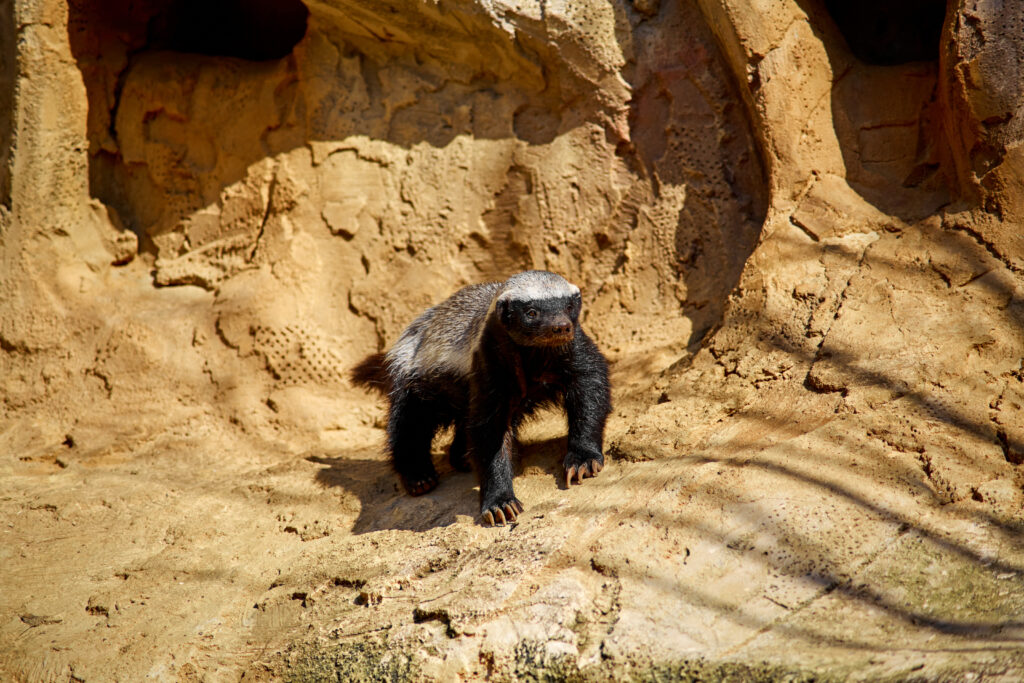
Fascinating Honey badger (Mellivora capensis)
The honey badger (Mellivora capensis) is the only surviving species in the genus Mellivora and the subfamily Mellivorinae.
The species name “capensis” originates from the Cape of Good Hope, where early specimens were first documented.
Up to sixteen sub-species were historically proposed based on variable colouration and size. Honey badgers are genetically closer to weasels and martens than to true badgers. They belong to the Mustelidae family, which includes otters, ferrets, wolverines, and polecats. “Ratel,” a common name for the species, comes from Dutch/Afrikaans and may refer to their rattling growl.
Fossil evidence shows honey badgers likely originated in prehistoric Asia before spreading to Africa. Adults measure roughly 55-77 cm in body length, with an additional 20-30 cm tail. They stand about 23-28 cm tall at the shoulder. Adult body mass typically ranges from 8 to 16 kg, with males noticeably larger than females.

Their hallmark coloration includes a pale grey or white mantle over a black underside. Their fur is coarse and sparse, protecting against rough terrain and stings but offering limited insulation.
Honey badger skin is extremely tough and loose, allowing the animal to twist inside its own hide if grabbed.
Their neck and shoulders are heavily muscled, giving them a strong, compact build. Their hide is notoriously difficult for predators to bite through or hold onto.
Long, curved foreclaws make them powerful diggers capable of breaking into burrows and hives. Their hind claws are smaller and adapted for traction rather than digging.
Honey badgers regularly dig temporary dens for resting or hunting.
Their eyesight is limited, so they rely largely on their sense of smell.
Their bold black‑and‑white coloration may act as a warning signal to potential predators. The species is widely distributed across sub‑Saharan Africa, the Arabian Peninsula, and South Asia. Their range continues into parts of Central and Western Asia, including regions of Iran and Turkmenistan. They avoid only the driest desert zones, such as the central Sahara.
They inhabit savannas, forests, grasslands, rocky terrain, and semi-desert environments. Honey badgers are mainly found at low to moderate elevations, although occasional records show they can survive at high altitudes of over 4,000 meters in parts of Africa.
They frequently use burrows left by aardvarks, porcupines, and other mammals.
In Namibia they are widespread but rarely found in the dune fields of the Namib Desert.
Surveys have recently confirmed honey badgers in coastal areas where their presence wasn’t previously recorded.
Their tolerance of many habitat types highlights exceptional ecological adaptability.
Honey badgers can survive in a wide range of habitats, from arid savannas and semi-deserts to areas with moderate rainfall, demonstrating remarkable adaptability.
Honey badgers are primarily solitary animals. Although honey badgers are mostly solitary, the large home range of a male often overlaps with the territories of several females, allowing for mating opportunities.
They are nomadic rather than territorial and travel widely while foraging. In the Kalahari, some male honey badgers have been recorded with home ranges exceeding 500 square kilometers, reflecting their nomadic lifestyle and the search for food and mates.

In a single night, a honey badger can cover more than 20 kilometers while hunting, roaming tirelessly in search of food. Honey badgers change when they are active: sometimes they are active at night (nocturnal), sometimes at dawn or dusk (crepuscular), and sometimes during the day (diurnal), depending on the weather and how many humans are around.
They communicate through growls, hisses, and rattling vocalizations. Anal-gland secretions and urine serve as important scent‑marking signals. When threatened, they stand their ground and engage in loud, aggressive displays. Although they spend most of their time on the ground, honey badgers are capable climbers.
Honey badgers are very clever and can solve tricky problems (problem-solving), and sometimes even use tools, like sticks or rocks, to get food when in captivity (living in zoos or wildlife centers).
Their diet is extremely varied and includes insects, rodents, reptiles, birds, eggs, fruits, roots, and carrion.
Honey badgers can even kill and eat venomous snakes, including cobras. Honey badgers are partly resistant to venom (poison from snakes), which means that if a venomous snake bites them, they might get temporarily paralyzed (unable to move for a short time) but usually recover afterward.
They frequently raid beehives for honey, larvae, and wax. Most of their water comes from the animals they eat (prey), which helps them survive in very dry places (deserts and savannas). They prefer live prey but also scavenge opportunistically. Their powerful jaws can crush tough‑shelled prey such as tortoises. Their broad diet helps regulate populations of rodents, reptiles, and insects.
When honey badgers dig (use their strong claws to move soil), they help air reach the soil (aerate it) and uncover animals and insects living underground.
They sometimes steal food from other predators, which can change how animals in the area hunt and survive. Breeding can occur throughout the year without a fixed season. Baby honey badgers grow inside their mother for about 50 to 70 days (gestation), before being born.
Females usually give birth to one cub, with twins being rare. Newborn cubs are blind, hairless, and completely dependent on their mother. Cubs begin accompanying their mother on hunts at about three months old. Young honey badgers remain dependent for up to a year.
Female honey badgers can have babies when they are about 12 to 16 months old, while males become able to father babies a little later, at around 2 to 3 years old (sexual maturity).Honey badgers usually live around 7-8 years in the wild, but can survive over 20 years when cared for in captivity, such as in zoos or wildlife centers.
They are classified as Least Concern, though declines occur in areas where snaring or persecution is common. In many African cultures, honey badgers symbolize courage, toughness, and resilience.

QUICK HONEY BADGER FACTS TO WOW YOUR FRIENDS!
Honey badgers can shrug off cobra venom, sometimes passing out and waking up hours later as if nothing happened.
Their skin is so loose and tough that they can twist inside it and bite a predator holding them.
They’re smart enough to use tools, including rolling logs or stacking objects to escape enclosures.
Honey badgers can travel over 20 km in one night searching for food.
Despite their name, they’re actually more closely related to weasels than true badgers.